
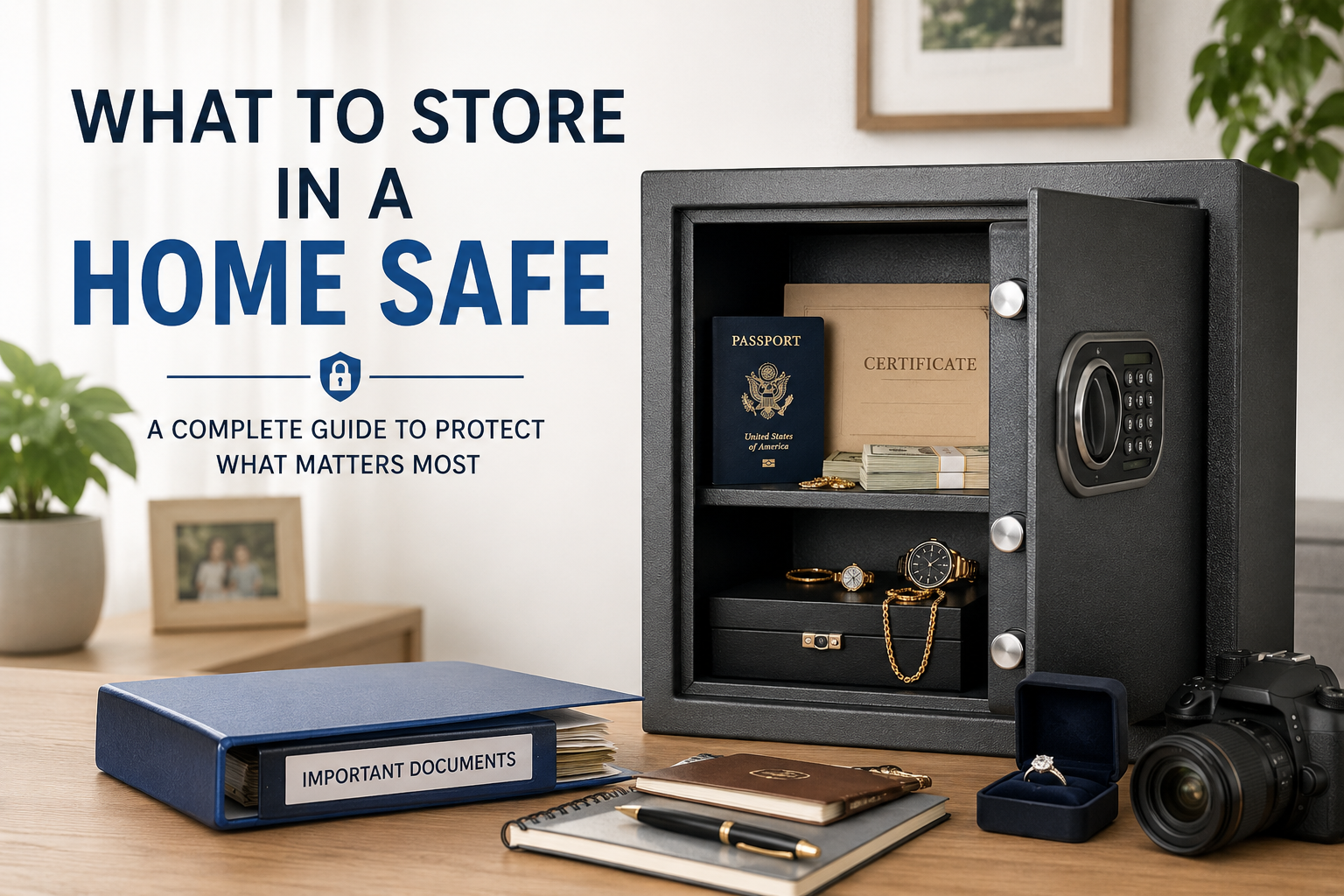
Most people buy a home safe with good intentions and then fill it with the wrong things.
They toss in a few random documents, maybe some cash, and call it done. Meanwhile, the items they actually need to protect most are sitting in a desk drawer or a filing cabinet, completely exposed.
This guide fixes that. Here’s exactly what should go in your home safe, what should absolutely not go in it, and how to organize everything so you can find what you need without digging around every time.
Your home safe should contain original identity documents, cash reserves, backup digital storage, jewelry and small valuables, and irreplaceable personal items. Do not store perishables, spare house keys that could compromise security, or items you need quick daily access to — safes are for protecting, not organizing.
What Should Go in a Home Safe?
Original Identity Documents
This is the most important category. These are the documents that are hardest to replace and most damaging if stolen.
- Passports — for every member of the household
- Birth certificates — originals, not copies
- Social Security cards — the physical card
- Marriage and divorce certificates
- Adoption paperwork
- Citizenship or naturalization documents
- Military discharge papers (DD-214)
Replacing any of these takes time, money, and bureaucratic patience. Some like original birth certificates from certain states or countries can be genuinely difficult to replace. Keep them in the safe.
Financial and Legal Documents
- Property deeds and titles to real estate
- Vehicle titles (car, motorcycle, boat, RV)
- Mortgage documents and loan agreements
- Stock certificates or bond documents (physical copies)
- Insurance policies — home, life, health, auto
- Wills and trusts — the signed originals
- Power of attorney documents
- Bank account information and account numbers (a printed summary)
- Safe deposit box keys (with a note of which bank and box number)
A critical note on wills: your will should be stored somewhere your family can access it without a court order if something happens to you. A safe that only you know the combination to can create a legal headache during an already difficult time. Consider leaving the combination with a trusted family member or attorney.
Cash Reserve
A certain amount of cash in your home safe is genuinely smart emergency preparedness.
If there’s a natural disaster, power outage, or financial system disruption, ATMs go down and electronic payments stop working. Having $500 to $1,000 in small bills gives you options when the grid doesn’t.
Keep it in small denominations — $20s, $10s, and $5s. Large bills are less useful in an actual emergency.
Don’t store more cash than you’re comfortable with from a home insurance standpoint — check your policy for coverage limits on cash kept at home. Most policies cap cash coverage at $200 to $500.
Jewelry and Precious Metals
Small, high-value items that can be pocketed easily during a burglary belong in the safe.
- Engagement rings and wedding bands when not being worn
- Heirloom jewelry
- Gold or silver coins
- Small collectibles with high monetary value
One important consideration: humidity. Jewelry — especially certain metals and gemstones — can be affected by moisture over time. If your safe isn’t fireproof (which means it’s also somewhat moisture-resistant), consider adding a small silica gel desiccant packet to absorb excess humidity.
If you have a large jewelry collection, a dedicated jewelry safe with humidity control features might be a better fit than a standard home safe.
Digital Backup Storage
This is a step most people skip, and they regret it.
A small USB drive or an external hard drive kept in your safe protects irreplaceable digital assets:
- Scanned copies of all your important documents (backup to the originals)
- Family photos that only exist digitally
- Important business files
- Cryptocurrency wallet seed phrases or hardware wallets
- Password manager backup files
Keep the drive updated every six months. A labeled, dated USB drive inside a fireproof safe gives you recovery options that cloud storage alone can’t guarantee — especially during a disaster that disrupts internet access.
Prescription Medications You Can’t Afford to Lose
Certain controlled or hard-to-replace medications are worth securing:
- Controlled substances (legally prescribed opioids, stimulants, etc.)
- Medications that are expensive or require long lead times to replace
- Emergency medications like EpiPens if you want a secure backup
Don’t store temperature-sensitive medications in a safe that might get hot — check storage temperature requirements first.
Spare Handgun (If You Own One)
A home safe is one of the best places to secure a handgun you’re not actively carrying. This is especially true if you have children in the home.
That said, if the reason you own a handgun is for home defense, your bedside safe (a quick-access model) makes more practical sense. A home safe that requires a combination isn’t the right choice if you need the gun quickly in an emergency.
Irreplaceable Sentimental Items
These are things money can’t replace:
- Old family photos (physical prints, especially pre-digital era)
- Letters from a deceased loved one
- Military medals or awards
- Rare stamps, coins, or collectibles with sentimental value
- Children’s genuinely irreplaceable keepsakes
The test: if your house burned down tomorrow, what would you wish you had grabbed? Put those things in the safe.
What not to store in a home safe
This is just as important as knowing what goes in.
Anything you need daily access to
A safe is not a filing system. If you’re opening it every day to get something, you’ll eventually stop locking it properly, or leave it open for convenience. Reserve the safe for things you rarely need but can’t afford to lose.
Extra house or car keys
This feels logical — keep the spare key somewhere secure, right? But think about what happens if someone breaks into your safe. You’ve just handed them the keys to your car and your house. Keep spare keys somewhere you can access them without opening the safe.
The Only Copy of Your Will
Wills exist to help your family after you’re gone. If only you know the combination, your loved ones may not be able to access the will when they need it most. Keep the original somewhere your executor or family members can access, and store a certified copy in the safe.
Perishable Items
Food, obviously, but also anything that degrades over time in a sealed, low-ventilation environment. Some medications, certain films, and items that need air circulation shouldn’t go in a sealed safe long-term.
Extremely large amounts of cash
Your home insurance policy almost certainly caps cash coverage in the event of theft or fire. Check the exact limit — it’s often surprisingly low. For large amounts, a bank is a better option.
Firearms and Ammunition (in large quantities)
A small amount of ammunition stored with a firearm is generally fine. But large quantities of ammunition in a fireproof safe create a risk during a fire — the heat, even inside a rated safe, can eventually cause it to cook off. Store bulk ammunition separately.
How to Organize Your Safe Properly
A chaotic safe is almost as bad as no safe. Here’s how to set yours up so you can find what you need:
Use labeled folders or envelopes. A simple manila folder for “Identity Documents,” “Insurance,” “Financial Records,” etc. keeps things searchable without having to unroll every document.
Put the most-needed items at the front. Passports and cash you might need in an emergency should be at the front or on top.
Use a small box or container for jewelry. Items rattling around loose in a safe get scratched. A small velvet pouch or a divided jewelry box prevents this.
Create a master document list. A single piece of paper listing everything in the safe, stored with a family member or attorney, helps others access what they need if you’re unavailable.
Photograph everything before storing it. A photo record of documents and valuables creates an evidence trail for insurance claims. Store the photos somewhere other than the safe — cloud backup or a family member’s email.
Frequently Asked Questions
Q: Should I store my will in a home safe?
You can store a copy, but be careful about who knows the combination. Your executor needs to access the will promptly after your death. Many attorneys recommend filing the original with the probate court or keeping it with your attorney’s office, with a copy in the home safe.
Q: How much cash should I keep in a home safe?
Enough for genuine emergencies — most financial advisors and security experts suggest $500 to $1,000. More than that reduces the practical need (banks and digital transfers cover larger amounts) and increases your exposure if the safe is compromised.
Q: Can I store a USB drive or external hard drive in a fireproof safe?
Yes, but with one important caveat: most standard fireproof safes are rated to protect paper documents, which survive up to about 350°F (177°C). Digital media like USB drives and hard drives can fail at temperatures above 125°F (52°C). If you’re storing digital media, look for a safe specifically rated for media storage, or use a fireproof media case inside your document safe.
Q: Should medications be stored in a home safe?
Controlled substances benefit from being kept in a locked safe; it prevents theft and keeps them away from children. But check storage temperature requirements before leaving any medication in a safe long-term, especially in a location that experiences temperature swings.
Q: How often should I update what’s in my safe?
Review the contents at least once a year. Update documents when they’re renewed (passports, insurance policies), refresh the USB backup drive with updated files, and replace cash that’s been sitting for years (bills can degrade over time in some conditions).
Q: Is it safe to store original documents in a fireproof safe?
Yes — a quality fireproof safe rated at 350°F interior temperature will protect paper documents from a standard house fire. Just make sure your safe has an actual fire rating from a testing organization (UL or ETL), not just a marketing claim from the manufacturer.
