
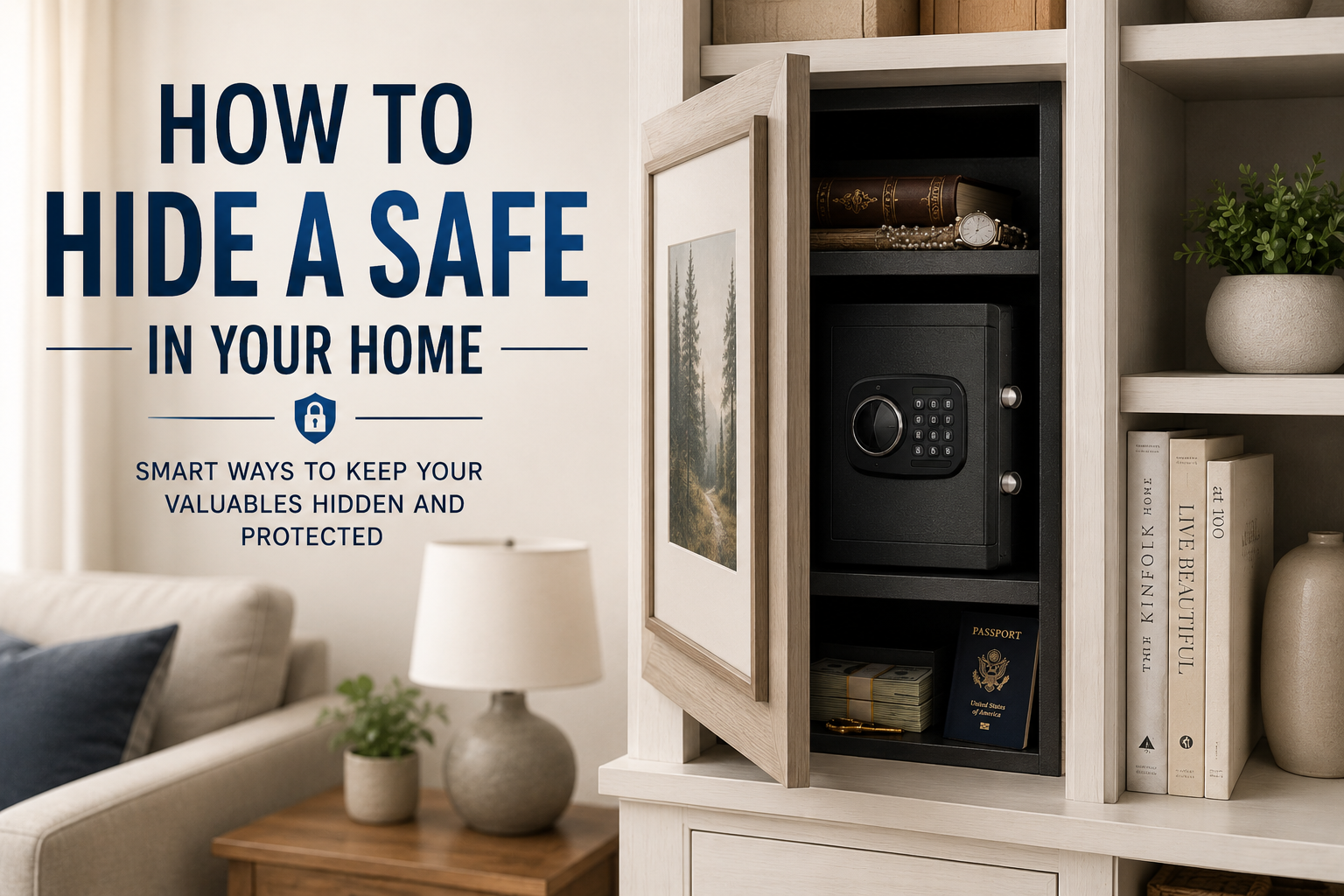
A safe that can’t be found can’t be stolen. That sounds obvious, but most people pick the least clever spots: the master bedroom closet floor, directly visible when the door opens, or the home office desk area. These are the first places a burglar checks.
The combination of a quality safe and a genuinely good hiding spot is far more effective than either one alone. A hidden safe buys you time, and time is what thieves don’t have.
Here’s every practical hiding spot, from the most effective to the surprisingly clever, with honest notes on what works and what doesn’t.
The best places to hide a safe are behind a false wall panel, inside a purpose-built piece of furniture for concealment, under the floor with a trapdoor, or inside a closet in a secondary bedroom, not the master bedroom. The master bedroom is statistically the first room burglars search.
Why Hiding Matters Even With a Bolted-Down Safe?
You might think: if my safe is bolted to the floor, why does hiding it matter?
Because a safe they can’t find can’t be attacked at all. Even a bolted safe can be defeated with enough time and the right tools. Burglars who can’t locate the safe in the first 2–3 minutes of a search often move on; they’re working against a time budget, not a technical challenge.
Concealment adds a layer of protection that no safe rating can replicate. It’s free, it’s permanent, and it works.
Location 1: False wall panel or bookshelf door
This is the gold standard of safe concealment. A section of wall paneling or a bookshelf that swings open to reveal a hidden space behind it, either a floor safe, a wall safe, or simply a compartment.
These exist as DIY projects and as purchasable products. Several furniture companies sell bookcases designed specifically as false doors, with concealed latches.
Why it works: Even if a burglar knows you have a safe, a false wall panel requires actively searching for it rather than spotting it visually.
Practical notes: This works best in homes with finished basements, studies, or bedrooms with built-in shelving. It requires either carpentry skills or a commercial product ($200–$800 for quality pre-built units).
Location 2: Under the floor (flush floor safe)
A floor safe installed into the concrete or subfloor, with a cover flush with the surface, is essentially invisible when covered by a rug, furniture, or flooring.
While you can bolt most safes to the floor, some models are specifically designed to be installed directly into the floor itself. These floor safes sit recessed into the concrete, with only the door visible at floor level.
Why it works: Even if someone knows where to look, accessing a floor safe requires moving furniture and getting on your hands and knees — not something a burglar wants to do.
Practical notes: Best installed in concrete floors (basement, garage, or slab foundation homes). Installation requires professional help or serious DIY skills; you’re cutting into a concrete floor. Cover with a heavy rug or furniture permanently placed over it.
Location 3: Inside an unused or guest room closet
The master bedroom closet is the number one target. Secondary bedrooms, guest rooms, children’s rooms, rooms that don’t get daily use are searched far less frequently.
A safe tucked into the back corner of a guest room closet, bolted to the floor, and covered with boxes or seasonal items, is genuinely well hidden.
Why it works: Burglars operate under time pressure. Secondary rooms get a quick scan, not a deep search.
Practical notes: Make sure the safe is still bolted down, even in a secondary location. Concealment reduces the chance of discovery; anchoring eliminates the chance of removal if it is found.
Location 4: Behind or inside furniture
Furniture specifically designed for concealment includes:
- Nightstands with hidden compartments accessed through the drawer or a false panel
- Ottoman storage units with a locked inner compartment
- Mirrors with concealed storage behind them
- Bed frames with built-in storage that lock
- Fireplace mantels with hidden compartments
Several brands sell furniture specifically designed as diversion safes at the furniture scale, full-sized pieces that look completely normal but contain a lockable hidden compartment.
Why it works: Blends completely with the room. Nobody thinks twice about a normal-looking nightstand or bookshelf.
Location 5: Inside the Wall (In-Wall Safe)
An in-wall safe sits flush between wall studs, covered by a painting, mirror, or decorative panel when not in use.
Why it works: Completely invisible when covered. Quick to access once you know where it is.
Practical notes: In-wall safes are typically smaller than freestanding models, good for documents, handguns, jewelry, and cash. Not suitable for large quantities of items. Most in-wall safes can fit a small pistol, making them good candidates for quick-access firearm storage. Installation requires cutting drywall and working between studs, a manageable weekend project.
Location 6: Beneath a staircase
The space under a staircase is often underutilized. A small door built into the drywall under the stairs conceals significant storage behind it, and it’s one of the last places a burglar thinks to look.
Why it works: Not an obvious search target. Easy to create a lockable access panel.
Practical notes: Works best in homes where the under-stair space is accessible from a finished area. Great for a medium-sized safe that doesn’t need regular access.
Location 7: The Kitchen, specifically the pantry
Counterintuitive, but effective. Burglars focus on master bedrooms, home offices, and living areas. The kitchen and pantry are rarely searched deeply.
A compact safe, a 0.5- to 1-cubic-foot model placed on a low pantry shelf behind food items, is surprisingly well concealed. It looks like an appliance or storage container from a distance.
Why it works: Nobody expects valuables in the kitchen. Burglars in a hurry won’t pull canned goods off shelves.
Practical notes: Keep it bolted if the pantry has a wood floor or is built over a subfloor. Works best for document storage rather than firearms, given the access pattern.
Location 8: In the Garage (But Not Where You Think)
Most people dismiss the garage as a bad location because it’s often the first point of entry for break-ins. But a safe built into a garage workbench, bolted beneath it and hidden behind tool storage, is genuinely hard to find.
Why it works: Disguised as part of the work environment. The visual clutter of a garage hides things effectively.
Practical notes: Choose a safe rated for temperature extremes if your garage gets very hot or cold. Add humidity control to prevent rust on stored firearms.
Location 9: Inside an HVAC closet or utility room
Utility rooms are functional spaces; they look like they contain only HVAC equipment, water heaters, or electrical panels. A safe tucked behind the water heater or in a corner of the utility room is genuinely overlooked.
Why it works: Utility rooms look like they contain nothing valuable. Most burglars don’t enter them.
Practical notes: Avoid placing a safe directly next to a water heater (moisture and heat exposure). A corner away from the equipment works well.
Locations to Avoid
Master bedroom closet, floor level. This is where everyone puts their safe and where every burglar looks first.
Home office, visible from the desk. Second most common, second most searched.
Directly behind the master bedroom door. Common position, obvious from the doorway.
Any location that requires moving the safe to get to it. If accessing your own safe is awkward, you’ll use it less consistently, which defeats the purpose.
A location that only one person in the household knows. If something happens to you, your family needs to be able to access it.
Balancing Concealment With Accessibility
The best hiding spot is one that you can access in a reasonable time but that a stranger wouldn’t find during a quick search.
For emergency-access items, a home defense firearm, for example, concealment shouldn’t slow you down significantly. A bedside quick-access safe with a discreet profile is a better choice than a deeply hidden floor safe for that purpose.
For long-term document and valuables storage, deeper concealment is worth the trade-off in access time.
Think about the two scenarios: daily or emergency access vs. long-term secure storage. Different items may call for different locations.
Frequently Asked Questions
Q: Should I tell anyone where my safe is hidden?
Yes, at least one trusted person. Your spouse, a family member, or an attorney should know the safe’s location and combination. If something happens to you, your family needs to be able to access important documents. Consider leaving sealed instructions with an attorney or in a will.
Q: Does hiding a safe replace the need to bolt it down?
No, these are complementary strategies, not alternatives. A hidden but unbolted safe can be carried out if found. A bolted-down but visible safe can be attacked in place. Hidden and bolted is the most secure combination.
Q: What’s the best hiding spot for a quick-access gun safe?
The inside of a nightstand (or a nightstand specifically designed as a concealed safe), mounted under a desk, or attached to the inside of a closet door, all work well. Speed of access matters here, so don’t choose a location that requires moving furniture or digging through stored items.
Q: Can I hide a safe behind a mirror?
Yes, and it’s one of the most effective methods. An in-wall safe covered by a framed mirror or a wall mirror with a hinged panel is nearly invisible. Make sure the mirror is secured properly so it can be opened and closed consistently without loosening the mounting.
Q: Should I tell my children about the safe?
It depends on their age and maturity. Children old enough to understand the importance of confidentiality should know that the safe exists (especially if it contains emergency documents or a firearm for home defense). They don’t need to know the combination unless there’s a specific reason. Never leave a firearm accessible to a child.
