
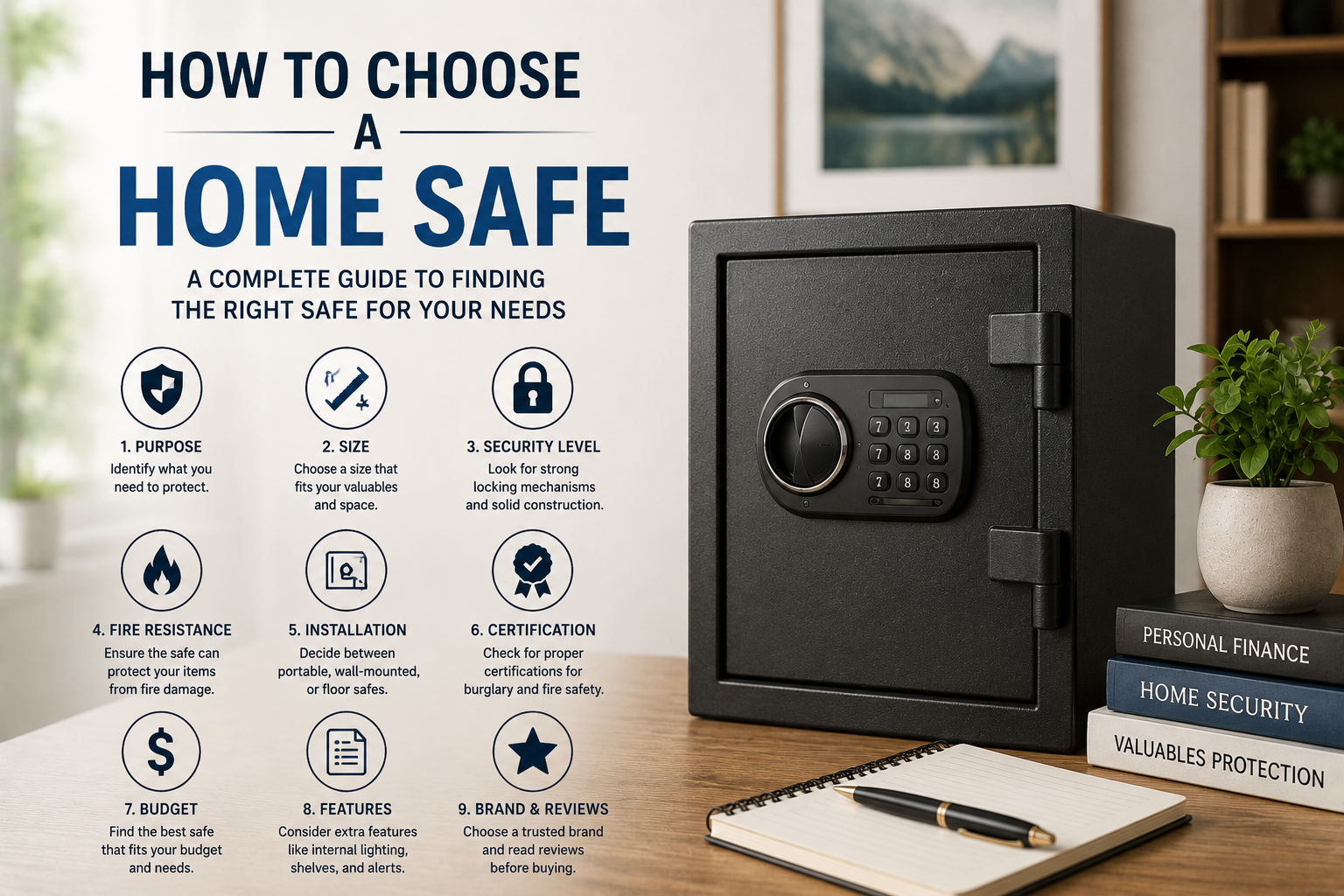
Buying a home safe sounds straightforward until you’re actually doing it. There are dozens of options, confusing spec sheets, marketing claims that don’t mean much, and prices ranging from $40 to $5,000. It’s genuinely hard to know what you’re looking at.
This guide cuts through all of it. By the end, you’ll know exactly what to look for, what the specifications actually mean, and which type of safe fits your specific situation.
Prioritize steel gauge (12-gauge minimum), a certified fire rating (UL or ETL, 30 minutes minimum), a reliable lock with key override, interior space that matches your needs, and pre-drilled anchor holes. Don’t buy any safe that lacks independent certification. Manufacturer claims without third-party testing are meaningless.
Factor 1: Steel Gauge, The Most Important Spec Nobody Talks About
Steel gauge is the number that most determines how resistant a safe is to physical attack, and almost no product listing explains it clearly.
Here’s the counterintuitive part: a lower gauge number means thicker steel. 12-gauge steel is significantly thicker and harder to penetrate than 18-gauge steel.
- 12-gauge: Quality construction. Resists pry attacks and basic power tools well.
- 14-gauge: Acceptable for most home use, harder to defeat than cheaper models
- 16-gauge: Minimum acceptable. Common in mid-range models.
- 18-gauge: Avoid for anything you care about protecting. Can be peeled open with a crowbar in minutes.
Budget safes under $80 almost always use 16 or 18-gauge steel. The door and body might look solid, but they’re not. The AmazonBasics safe uses heavy-duty carbon steel with an 8-gauge steel door that’s worth noting because door thickness and body thickness are often different specs.
Always look for the gauge specification. If the product listing doesn’t mention gauge, assume it’s thin.
Factor 2: Fire Rating What the Certifications Actually Mean
A fire rating tells you how long a safe can withstand a fire while keeping the interior below a temperature that destroys its contents.
Paper ignites at 451°F. Most fire-rated safes are designed to keep the interior below 350°F. Digital media USB drives and hard drives fail at around 125°F. If you’re storing media, you need a safe specifically rated for it.
What to look for:
- UL Classified: Testing by Underwriters Laboratories, the most respected independent standard. Levels include 30 minutes, 1 hour, and 2 hours at specified temperatures
- ETL Verified: Similar independent testing, widely accepted
- “Fire resistant” with no certification: A marketing claim. Meaningless without third-party verification
The minimum you should accept is 30 minutes at 1,550°F with UL or ETL certification. The SentrySafe SFW123GDC is UL fireproof rated to protect important documents and digital media against heat reaching 1700°F for up to an hour, ensuring the interior temperature will remain below 350°F. That’s the standard to benchmark against.
One hour of fire protection covers the vast majority of residential fires, which burn for an average of 30–45 minutes before fire suppression arrives.
Factor 3: Lock Type Matching the Lock to Your Actual Use
Digital keypad: The most popular and for good reason. Reliable, fast to open, and easy to change the combination. Main weakness: battery dependency. Always choose a model with a physical key override backup and an external battery contact for emergencies.
Biometric (fingerprint): The fastest access of any lock type. Excellent for quick-access gun safes and nightstand safes where seconds matter. Modern biometric readers are accurate and reliable; the technology has improved significantly in the past five years.
Combination dial (mechanical): The most durable in the long term. No batteries, no electronics to fail. Slower to open. Good choice for document storage where speed isn’t critical. Some users find it frustrating for regular access.
Key lock only: Avoid as a primary lock. Keys get lost, copied, or fall into the wrong hands. Only acceptable as a backup override alongside an electronic lock.
Our recommendation: Digital keypad with key override backup for most buyers. Biometric if speed of access is your priority. Mechanical dial if you want zero battery dependency.
Factor 4: Interior Size Sizing Right the First Time
Buyers consistently underestimate how much space they need. The safe looks large in the product photos. In your closet, with your actual documents and items inside, it fills up fast.
A useful rule: buy the next size up from what you think you need.
Size guide:
- 0.5 cubic feet: One handgun, a small folder of documents, and little else. Suitable for a dedicated pistol safe
- 1.0–1.5 cubic feet: Standard family home safe. Fits passports, birth certificates, insurance documents, a handgun, some jewelry, and a USB drive with room to spare
- 2.0+ cubic feet: Larger families, businesses, or anyone storing multiple items. The SentrySafe 2.0 cu ft model holds full binders laid flat
Also check interior dimensions specifically, not just cubic footage. If you need to store legal-size documents (8.5 × 14 inches) flat, confirm the interior length accommodates them. Some 1.2 cubic foot safes require legal documents to be stored angled or rolled.
Factor 5: Anchoring Non-negotiable
Every safe you consider should have pre-drilled anchor holes in the base. This is a quick, easy filter: if the product listing doesn’t mention anchor holes or a bolt-down kit, skip it.
An unanchored safe under 150 lbs can be carried out by two people in under a minute. Anchoring converts your safe from a portable container to a fixed security installation. It takes 30–60 minutes, costs nothing extra if your safe includes hardware, and eliminates the most common method of safe theft.
What to ignore in listings
“Fireproof” without a rating: Every cheap safe claims to be fireproof. Without UL or ETL certification, it means nothing.
Interior lighting: Nice to have, not a security feature. Don’t let it influence your decision.
Exterior appearance: Chrome handles and brushed steel finishes are cosmetic. They tell you nothing about the quality of the steel body or the lock mechanism.
Weight as a proxy for quality: A heavy safe is generally better than a light one, but weight alone doesn’t tell you the gauge or the certifications. Use it as a rough indicator only.
Budget Guide
| Budget | What you get | Best for |
|---|---|---|
| Under $100 | Thin steel, basic lock, no fire rating | Temporary, low-value items only |
| $100–$200 | 30-min fire rating, digital lock, reasonable steel | Most households, documents + small valuables |
| $200–$400 | 1-hr fire rating, better steel, water resistance | Family home, jewelry, firearms + documents |
| $400–$800 | Premium construction, larger capacity, biometric options | Serious home security, valuable collections |
| $800+ | Commercial-grade, gun safe territory, multiple locking bolts | Gun collections, business use |
Frequently Asked Questions
Q: What safe does SafeSever recommend for most families?
The SentrySafe SFW123GDC hits the sweet spot of price ($130–$170), fire protection (1 hour, UL rated), size (1.23 cu ft), and reliability. It’s the most consistent performer in its price range and has earned its reputation over years of real-world use.
Q: Should I buy from a hardware store or online?
Online gives you a wider selection and better prices. The main downside is that a large, heavy safe is difficult to return if there’s a problem. Read the return policy carefully, and buy from a retailer (Amazon, Costco) with a straightforward return process.
Q: Is a more expensive safe always better?
Not always. Beyond ~$400 for a home safe, you’re paying for size and additional features rather than meaningfully better protection. A well-chosen $200 safe protects a typical home’s valuables as effectively as a $600 model. Spend more only when you need more capacity or specific features.
Q: What’s the minimum fire rating I should accept?
30 minutes with UL or ETL certification. That protects your documents in the vast majority of residential fires. If you live in a remote area where fire response times are longer, step up to a 1-hour rated model.
Q: Can I move my safe after anchoring it?
Yes, with some effort. The anchor bolts can be removed, the safe repositioned, and re-anchored in the new location. It’s a 30–60 minute job. Plan the placement carefully before anchoring to avoid doing it twice.
